Expanded EU Risk Criteria and New Control Measures for Organic Imports 2026 | | | We are glad to share bio.inspecta requirements on additional official control on products originating from certain third countries. | | | Following the adoption of Commission Delegated Regulation (EU) 2025/2651, which amends Article 8 of Delegated Regulation (EU) 2021/1698, the criteria for identifying “high-risk” products and countries have been broadened to allow a more comprehensive risk-based approach.
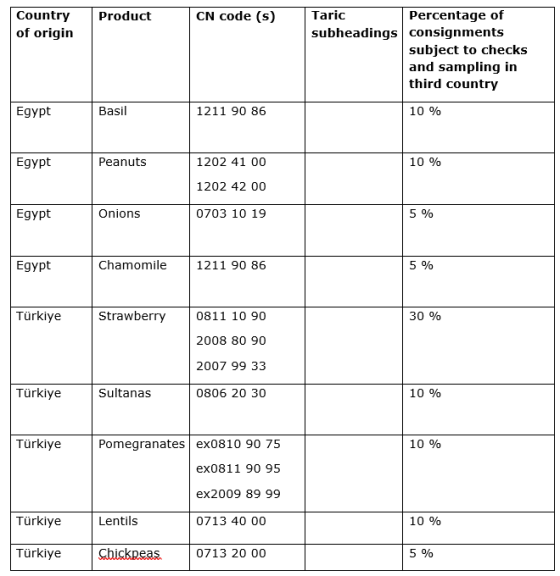
For the year 2025, additional control and reporting measures were implemented in compliance with DG AGRI guidance, as specified in Section 1.1 of the Ares(2024)8617864-03/12/2024 (Letter of the EU Commission dated 03/12/2024). As no such list has been issued for 2026, bio.inspecta has carried out a documented risk assessment using data extracted from the Organic Farming Information System (OFIS), accompanied by the evaluation of established and suspected cases as well as major or critical non-compliance impacting the integrity of organic and in-conversion products. This assessment has identified certain imported products-country combinations have been classified as high-risk, for which additional control and reporting measures have been established and implemented for 2026.
This approach ensures consistency with the amended regulatory framework and maintains the integrity of organic certification. | | | bio.inspecta established the guidelines according to its own based Risk-Assessment resulting from 2025, taking into account of the article 9.2 of Regulation 2021/1698; the Guidelines of 2025 and the draft of list of High-Risk Products /Countries that will be applicable for 2027. | | | bio.inspecta ensure that these additional control measures should be applied exclusively to the following products and the operators producing, preparing, trading, storing or exporting organic food and feed with the following CN-codes. | | | Requirements of Increased Control Measures | | - At least 2 physical inspections per year, one of these unannounced.
- Inspection before sowing of the first certified crop for farms certified for the first time.
- At least one sample per year (for producers, it is compulsory to be a field crop sample). This requirement is without prejudice to the export consignment sampling.
- Increased control on traceability and flow of products.
- Increased control on bookkeeping and financial documentation (accounting).
- Increased control on means of transport and storage.
- Information must be kept ready for inspection about all sales of organic products as conventional, including quantities and names of buyers.
- Export consignment sampling and analysis assessment before issuing a COI: For the products defined above, a minimum of 5%,10% or 30% of all export consignments needs to be sampled and analysed for the presence of unallowed substances. The percentage is calculated for each concerned product of each concerned operator for the period between 01.05.26 - 31.12.26. Please refer to information about the sampling/ analysis procedure and timelines in the information leaflet, Certification of Inspection (COI).
| | | Please refer to the letter ‘High Risk Products and Countries_bio.inspecta’ for further requirements and details. | | | bio.inspecta international team is available to support you in any step, please do not hesitate to contact us or your local partner if you have any questions!
Kind regards,
Your International team at bio.inspecta AG
| |
|
|
|
|
Member of:
|

|
|
|
|
|